
Comprehensive Neuropsychological and Cognitive Assessment in Calgary
Doctoral-level neuropsychological assessment examining memory, attention, executive functioning, learning, language, processing speed, emotional functioning and other abilities to clarify how brain functioning relates to everyday life.
Book an AssessmentFree 15-Minute Consultation







Understand the factors affecting thinking, learning and daily functioning
A neuropsychological assessment examines how brain functioning relates to cognition, emotions, behaviour and everyday performance. It can help clarify why a person is experiencing changes or longstanding difficulties involving memory, concentration, planning, learning, communication or problem-solving.
Assessments are provided under the clinical leadership of Dr. Courtney Dookie, Registered Psychologist, with declared competence in Clinical Psychology and Neuropsychology. The emphasis is on differential diagnosis, integrated interpretation and recommendations that can be applied in healthcare, education, employment and daily life.
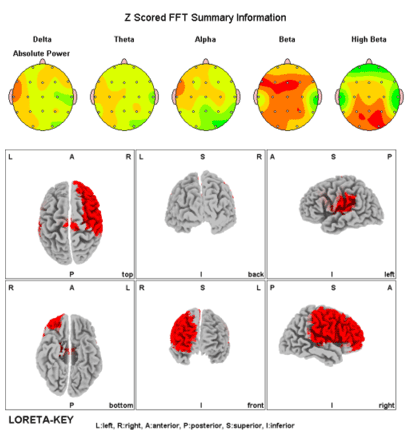 Brain-mapping data may complement neuropsychological testing when clinically appropriate. It does not replace standardized neuropsychological assessment or diagnostic evaluation.
Who may benefit from a neuropsychological assessment?
Adults and older adults
For concerns involving memory, attention, executive functioning, neurological illness, injury, medical treatment or changes in independent functioning.
Children and adolescents
For complex learning, attention, developmental, medical or neurological histories requiring a broader understanding of cognitive and academic functioning.
Families and referring professionals
For families, physicians, rehabilitation providers, schools, legal professionals and clinicians seeking diagnostic clarification and practical recommendations.
Common reasons for referral
Cognitive changes
Memory loss or forgetfulness, reduced concentration, slower thinking or processing, planning and organizational difficulty, language changes or problem-solving concerns.
Neurological or medical factors
Traumatic brain injury, concussion, stroke, epilepsy, seizure disorders, complex medical treatment, neurological conditions or questions about cognitive decline.
Developmental and learning concerns
ADHD, executive-function concerns, autism, learning disorders, developmental conditions and complex school or workplace difficulties.
Areas that may be assessed
Attention and processing
Sustained attention, working memory, processing speed and efficiency in managing information.
Learning and memory
How verbal and visual information is learned, retained and recalled over time.
Executive functions
Planning, organization, inhibition, mental flexibility, problem-solving and self-monitoring.
Language and visual-spatial skills
Language abilities, visual-spatial reasoning and construction when relevant to the referral question.
Academic functioning
Reading, writing and mathematics skills when learning or educational concerns form part of the referral.
Emotional and behavioural functioning
Mood, anxiety, personality, behaviour and adaptive functioning when clinically appropriate.
What the assessment process involves
Initial consultation
We clarify the referral question and determine whether neuropsychological assessment is appropriate for your needs.
Clinical interview and record review
Relevant developmental, educational, medical, occupational and psychological history is reviewed. Additional records or collateral information may be requested.
Individualized testing
Standardized measures are selected according to the referral question. Testing time varies based on age, complexity and the domains that must be examined.
Integrated neuropsychological interpretation
Results are interpreted in relation to history, observed functioning and available clinical information. Alternative and co-occurring explanations are considered.
Feedback and written report
Findings are explained clearly and the report provides individualized recommendations for treatment, rehabilitation, school, work or daily functioning.
Related Calgary assessment services
ADHD Assessment →
Comprehensive assessment for adults, children and teens with attention and executive-function concerns.
Psychoeducational Assessment →
Assessment of cognitive and academic functioning for learning, school and accommodation questions.
Psychological Assessment →
Evaluation of emotional, behavioural, diagnostic and functional concerns.
Adult Autism Assessment →
Evaluation of developmental history, social communication and current functioning.
Child Autism Assessment →
Family-centred autism assessment with individualized recommendations.
Professional referrals
Referral questions from physicians, rehabilitation providers, educators and other professionals are welcome.
Frequently asked questions
How long does a neuropsychological assessment take?
The time required varies according to the referral question, age, complexity and assessment measures. Testing may take several hours and can sometimes be divided across appointments.
What should I bring to the assessment?
Bring requested medical, educational or previous assessment records, a list of medications, corrective glasses or hearing devices, and any information identified during your consultation.
Will I receive a diagnosis?
When diagnosis is part of the referral question, findings are considered using clinical history, standardized results and relevant diagnostic criteria. Not every assessment results in a diagnosis.
Will I receive a written report?
Yes. The report explains the findings and provides individualized recommendations. The intended recipients and any consent requirements are discussed with you.
Are assessment results confidential?
Assessment information is handled according to applicable professional, legal and privacy requirements. Information is released to other parties only with appropriate authorization or when otherwise required by law.
Looking for a neuropsychological assessment in Calgary?
Start with a consultation to discuss your concerns, the referral question and the assessment pathway that best fits your needs.
Book an AssessmentFree 15-Minute ConsultationQuick answers
Neuropsychological assessment in Calgary
What does it assess?
It evaluates cognitive abilities such as attention, memory, processing speed, executive functioning, language and visual-spatial skills, selected according to the referral question.
Who may benefit?
Children, adults and older adults may be referred for concussion or brain injury, neurological or medical conditions, cognitive change, complex ADHD or learning concerns, and questions about daily functioning.
Who leads the service?
Assessments are provided under the clinical leadership of Dr. Courtney Dookie, Registered Psychologist, with declared competence in Clinical Psychology and Neuropsychology.
Related services: ADHD assessment, psychoeducational assessment, MVA assessment and neurofeedback and qEEG.
From cognitive assessment to brain-health planning
If your goal extends beyond diagnostic clarification to focus, resilience, cognitive performance or proactive brain health, explore our clinician-guided optimization pathway.
Explore the Brain Optimization pathway →